An interactive CD-ROM for CNES: a virtual visit of the plane that cancels gravity, the science on board, and 360° views shot while floating in weightlessness.
Some science only works without gravity. Flames, bubbles, dust clouds and the human body all behave differently when weight disappears, and a space station is a long way to go to find out. A specially modified Airbus A300 could give researchers that state for about 22 seconds at a time, again and again, in a single flight.
In 2001 CNES, the French space agency, asked Doo Interactive, the studio I had started on my own in 1998, to explain all this to the public on a CD-ROM: what weightlessness really is, how a plane can create it, and what scientists do with those few seconds. By then Doo was a team, and we built it around a virtual visit of the plane, shot in 360° in flight, and updated it in 2003.
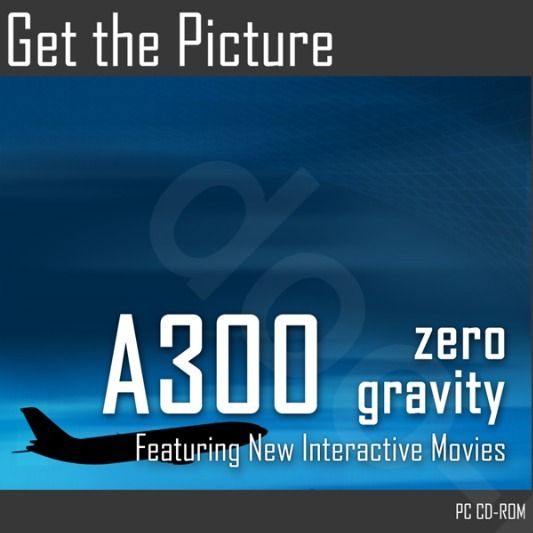
The 2003 edition: "A300 zero gravity", featuring new interactive movies.
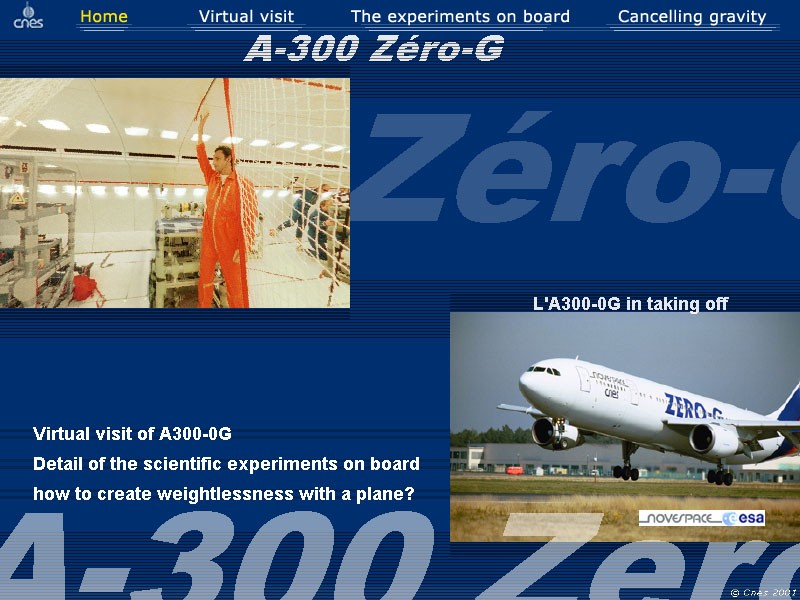
The 2001 disc, in French and English: a virtual visit, the experiments on board and how to cancel gravity.
The aircraft
The plane that cancels gravity
CNES created Novespace in 1986 to run its parabolic flights from Bordeaux-Mérignac. After a Caravelle, an Airbus A300 fitted out for the job took over in 1997: the A300 Zéro-G. Its cabin was stripped and padded into about 100 m² of floating laboratory, used by CNES, the European Space Agency, the German aerospace centre DLR and others.
It retired in late 2014 after more than 13,000 parabolas, about 80 hours of weightlessness in total, and flew its last trip to Cologne/Bonn airport, where it is now on display. An Airbus A310 Zero G took over in 2015, and since 2013 members of the public can book a flight too.
1997–2014
in service
13,000+
parabolas flown
113
scientific campaigns
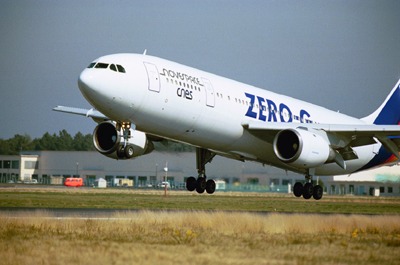
The A300 Zéro-G taking off, as shown on the disc.
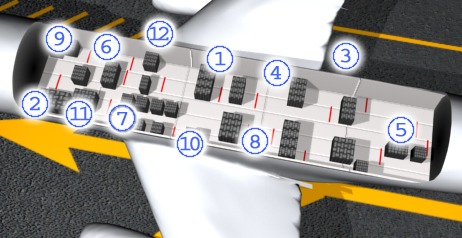
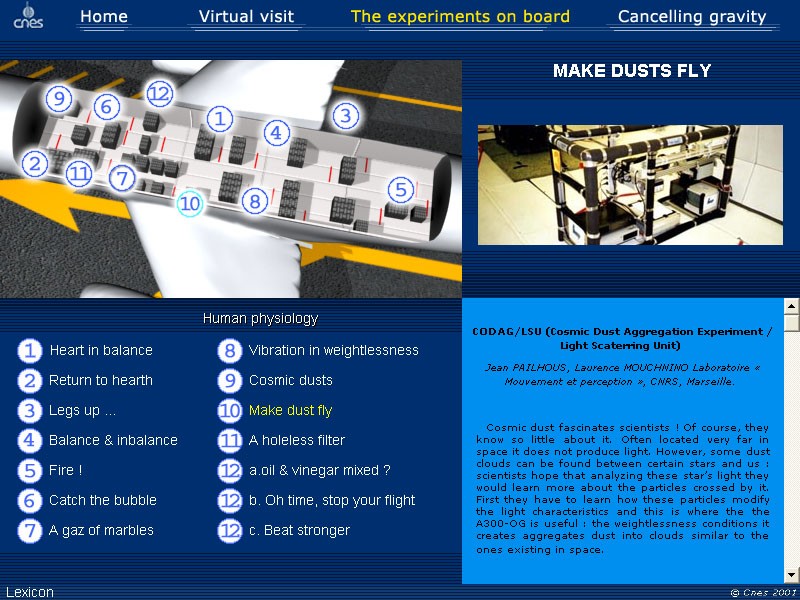
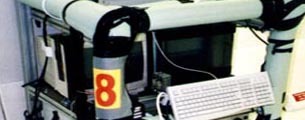
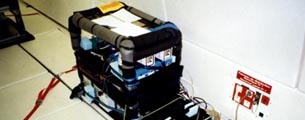
The experiment zones in the cabin, numbered as on the disc.
Cancelling gravity
Falling, on purpose
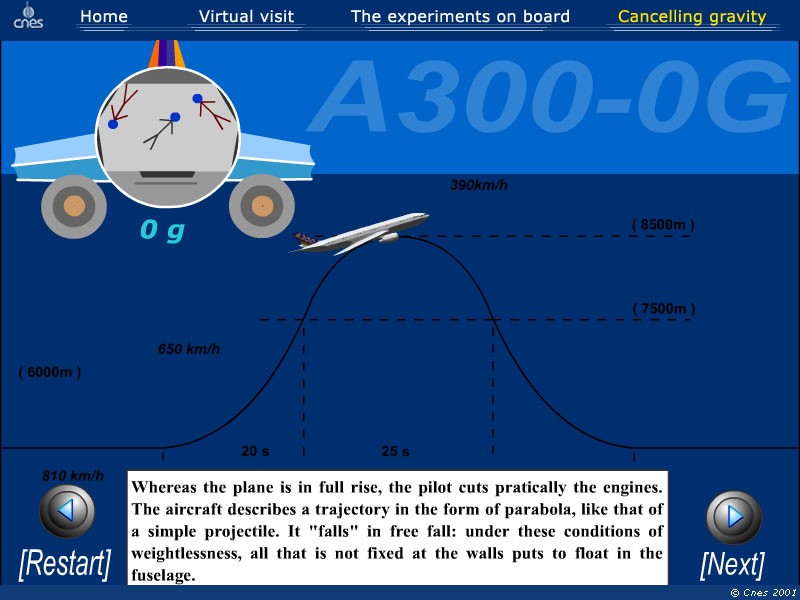
The trick is a parabola. From level flight the pilots pull the nose up steeply, and everyone on board weighs nearly twice their normal weight. Then the engines are throttled back until they only cancel air drag, and the plane, its passengers and every loose object follow the same ballistic curve, like a thrown stone. They are all falling together, so nothing presses on anything: for about 22 seconds, everything floats. The pilots then pull out of the dive, heavy again, and set up the next one. A flight strings about thirty of them together.
The disc explained it with an animated profile of the manoeuvre, climbing from about 6,000 to 8,500 m. In 2001 it promised “approximately 30 seconds” of weightlessness; today’s figure from CNES and DLR is 22.
"Cancelling gravity": the parabola, as animated on the 2001 disc.
The experiments on board
Twelve experiments, explained for everyone
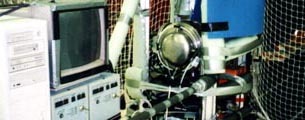
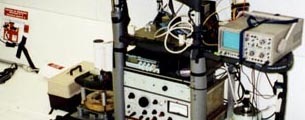
The heart of the disc was a guided tour of the research on board, one experiment at a time, each placed on a plan of the cabin. A few of them:
Fire! On Earth hot gas rises and carries smoke away. Without weight there is no convection: flames change shape and smoke stays put, which matters for fire safety on a space station.
Catch the bubble. An air bubble in heated silicone oil starts to pulse “like a heart beating”. The effect drives heat transfer, the same physics used to cool satellites.
A gas of marbles. On the ground, tiny bronze and steel beads just pile up. Floating, they behave like a gas, which helps explain why some rocket propellant ingredients refuse to mix.
Make dust fly. A laser through suspended dust shows how cosmic dust scatters light, a model for the CODAG/LSU cosmic dust experiment.
Heart in balance. Astronauts can black out when they come home. A low-pressure chamber around the legs draws blood down, and the A300 let researchers test it.
Legs up. Filming a simple step without gravity helps understand movement in patients with one-sided paralysis.
Each experiment was placed on a plan of the cabin, with its own explanation sheet.
Shooting with no up or down
360° in weightlessness
The virtual visit was shot in flight by my old school friend Frédéric Swierczynski. We met at the Lycée Gustave Eiffel; he had already been my light man in the caves for Lascaux II. An iPIX view needs two fisheye shots, back to back, from exactly the same point. On the ground that means a tripod and a rotating head. In the A300 there is no ground to stand on for 22 seconds, the photographer floats with everyone else, and every parabola ends with the floor coming back up at you.
Seven views shipped on the 2001 disc, from the rear of the cabin to the front seats, one per zone of the plane. An eighth comes from a later flight in 2004. Here they are, converted in 2026 from the protected files on the disc into standard panoramas: drag to look around, and look for the people floating upside down.
Closing a loop
A space technology, used to show space research
iPIX itself came out of space research. It began at TeleRobotics International in Tennessee, whose Omniview system gave an operator pan, tilt and zoom inside a fisheye image with no moving parts, so robots could be steered by video. NASA’s Langley Research Center funded the work through a Small Business Innovation Research contract, and the team presented it at a NASA Johnson Space Center workshop in 1993. The company later became Interactive Pictures, then IPIX.
So a technology developed for space robots ended up, in our hands, documenting space research in a plane that recreates weightlessness. Years later I patented my own method for stitching two fisheye hemispheres into one image. The loop keeps closing.
2001 → 2003
An update, and a series
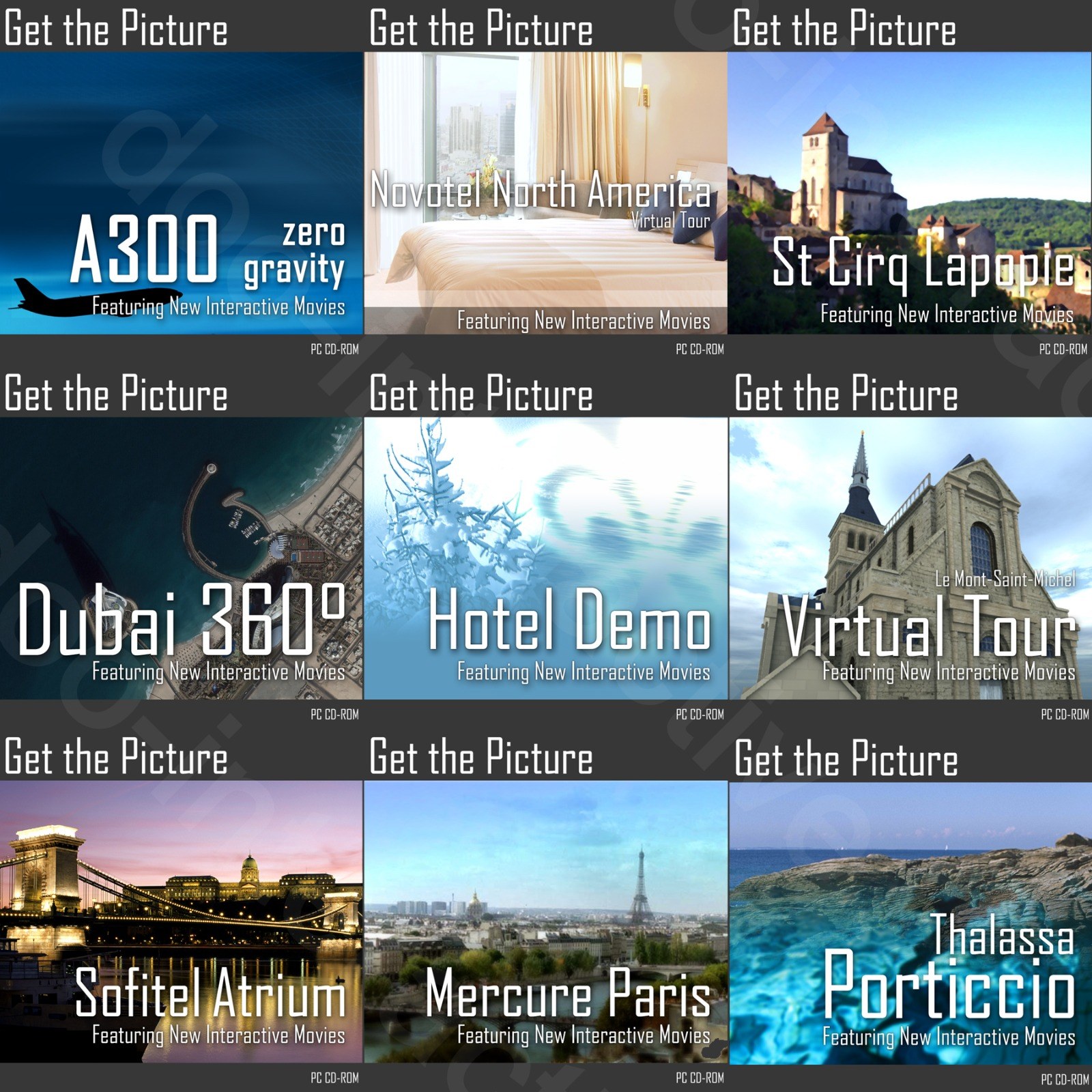
In 2003 the disc was updated with new “interactive movies” in MPEG video and became part of our Get the Picture collection of PC CD-ROMs, alongside hotels, heritage sites and cities.
The Get the Picture collection. The A300 is top left.
Underground, air, space
One story in three chapters
From the caves of the Périgord to a plane that cancels gravity, and on to satellites in their clean rooms: the same craft, the same people, further each time.
1 · Underground
Biron & Lascaux II
Two heritage CD-ROMs, 1999. Fred lit the Lascaux II replica.
Interactive CD-ROM produced by Doo Interactive for CNES, with Novespace, 2001; updated 2003. Direction and interactive design: Stéphane Jacob, with the Doo Interactive team of video editors and multimedia producers. 360° photography in flight: Frédéric Swierczynski.
I founded Doo Interactive alone in 1998. From 2001 on I led the studio and every production, but none of them was a one-man job: this disc, like the ones that followed, was teamwork.
Facts: CNES, Novespace / Air Zero G, DLR, NASA Spinoff and NASA Technical Reports Server.